Wednesday, August 17, 2022

Why FBC Farmersville Remains Enthusiastically Southern Baptist

This is the third in a series of blog posts about the Southern Baptist Convention. The previous posts are:

I've put a lot of work already into a post suggesting a way forward on the Credentials Committee, the office of pastor, the role of The Baptist Faith & Message, and such matters. I thought that was going to be the next post, but to be honest, it's something of a Lernaean Hydra at this point, and I need to work harder at getting it all organized into something readable. If I can avoid it, I don't want to post anything that has more tangles than does Matt Henslee's beard.

The long-and-short of that post is the office of pastor (not just "senior pastor," I think) is limited to qualified men. I think Southern Baptists should stand firm on that position. We can do that in ways that affirm women serving our churches both with words and with equity in pay and taxation—ways that you may not have considered. Also, there's an examination of the unprecedented demands that we are placing on an SBC structure not designed to handle them. Oh, yeah…nearly forgot…there's an attempt to construct a biblical theology of how to handle doctrinal and behavioral disputes among autonomous local churches.

Like I said, there's a lot there, and although I'm confident in the content, I'm dissatisfied with the organization of it all. So, you'll have to wait for that.

Staying Southern Baptist: A Case that Makes Sense for Us

Anyway, as promised, here are some reasons why FBC Farmersville is all-in on being Southern Baptist.

The SBC is far-and-away the most efficient way for FBC Farmersville to plant doctrinally sound churches around the country and around the world. Some of the glass-half-empty folks, and especially the glass-has-a-hole-in-the-bottom folks will suggest that a post like this one comes from some "company man" who is just a member of the booster club—someone who shuts his eyes to flaws or differences in the Southern Baptist Convention. But I have not been silent about what I count as mistakes and failures in the Southern Baptist Convention.

  • I was vocally critical of The Camel Method back when it was being used and promoted within the International Mission Board (I wrote A LOT about that, but this article is as good a place as any to see a summation).
  • As someone whose ecclesiological dial is set about 2 clicks shy of full-blown Landmarkism, I've walked away from domestic church-planting partnerships that involved churches who were, in my estimation, not sufficiently committed to one or two principles of Baptist ecclesiology that I consider to be important for church health.
  • I strongly criticized some ways in the recent past that the SBC has tried to manage the idea of Sole Membership and the attempts by some to avoid waiving attorney-client privilege as requested by the messenger body.

And yet, even for the ways that I have found fault in the past and the ways that I may find fault in the future, I'm still dedicated to the path of cooperation through the Southern Baptist Convention. Here are some reasons why:

  1. FBC Farmersville could not feasibly accomplish outside the SBC what we accomplish inside the SBC. And I'm willing to put that in terms of what we accomplish in the strictest construal of our own beliefs.

    Let's assume for a moment that only 10% of IMB missionaries and NAMB church planters have beliefs that line up very closely with those of FBC Farmersville (not Reformed, robustly-congregationalist, convictionally-Baptist-and-proud-of-it, strictly-complementarian, etc.). I think the number is higher than that, but let's go with 10%. That means that FBC Farmersville is supporting more than 350 IMB missionary units who are very closely aligned with our theology.

    Yes, there are IMB missionaries who are Reformed, a little more broadly ecumenical, more prone to entrust most governance to "lay-elders," etc. But even they, every one of them, falls within the doctrinal parameters of The Baptist Faith & Message. Why should I focus on the ones with whom I have some disagreements to the absolute exclusion of the dozens of missionaries who closely agree with my church?

    If I choose to "take my toys and go home," how long would it take FBC Farmersville to build a network of 350 missionaries around the globe who are serving with beliefs that line up perfectly with those of my church? The answer? Longer than my remaining natural lifetime. For us, the choice to leave the SBC would be the deliberate choice to be less effective in sharing the gospel around the world.

  2. FBC Farmersville benefits from SBC ministries, and it is only right for us to support those ministries. Every member of our ministry staff is a graduate from an SBC seminary. My predecessor was an SBC seminary graduate. His predecessor was an SBC seminary graduate and is presently a professor at an SBC seminary. That pattern continues back well before I was born. I expect that it will continue beyond my tenure here.

    This point is not entirely separate from the prior point. SBC seminaries graduate Methodist students, Presbyterian students, Non-Denominational students—I even had an Episcopalian classmate once upon a time. If you pay the tuition you can take the classes. Also, SBC seminaries turn out some Southern Baptist students who would not be a good fit at FBC Farmersville.

    Does the fact that our seminaries graduate some students we wouldn't hire count as a good reason to walk away? Why should it!? What's important to us is that the SBC's seminaries consistently graduate multitides of students every year who are exactly what FBC Farmersville wants and needs in terms of pastoral leadership and staff leadership. For that reason, even if we were to leave the Southern Baptist Convention, we would still be using not only seminary education but also a dozen other resources produced by Southern Baptists.

    We want to support what we consume. Especially since…

  3. FBC Farmersville gets to govern the ministries that serve us and that we support through the SBC. The SBC process respects not only the autonomy of the local churches but also the authority of the local churches. Jesus founded churches, not conventions. Our church appreciates the opportunity afforded by SBC polity for us to have our say, alongside the voices of the other messengers sent by the churches, in the ways that our money is spent.

    Churches are fallible, but I trust this church-centered process to yield the right outcomes over the long haul.

    I think the messengers' response to clergy sexual abuse at the 2021 and 2022 Annual Meetings is a good example. Our churches are asserting themselves, saying clearly that they want to honor Christ by preventing clergy sexual abuse. The Spirit of God moves through these messengers, and over time, He refines and reforms us.

    But even when they get it wrong…

  4. Error at other churches doesn't, just by virtue of our mutual affiliation in the SBC, compromise my church's integrity. That doesn't mean that there's no good reason to disfellowship wayward or apostate churches. It just means that the reason to do so isn't that I have to fear that my own church's health or orthodoxy is determined by the health and orthodoxy of a congregation across the continent.

    My church can fund cooperative missions through the Southern Baptist Convention while retaining our own autonomy. We're not entangled with the other churches in the convention by way of our using the same mission board any more than we are entangled with Mormons by voting predominantly for the same political candidates or are entangled with a drug pusher who may use the same bank that we use.

    Again, doctrinal error at any of our SBC entities is worth correcting, and the disfellowshipping of churches who have gone astray is a thing worth doing, but not because our autonomous church is somehow sullied just be our being in the Convention together with one another. No. We correct the course of entities and we disfellowship churches when doing so is needed to protect our cooperative ministries.

    This is why the leaders of the Conservantive Resurgence were content to declare "Misison Accomplished" while there were still CBF churches affiliated with the SBC. The boards were populated with biblical inerrantists. Biblical inerrantists filled all of the entity-head slots. CBF churches were entirely unable to shape the ministries of the SBC. The lingering presence of those CBF churches posed no threat to the health and stability of our churches. Certainly they constituted no good reason to part ways with the SBC. That's still true 30 years later.

    So, I shouldn't act like my church is somehow corrupted by the mere presence within the SBC of another church whose practice or doctrine I find offensive.

So, for all of these reasons, even when we see something happen in SBC life with which we may disagree, FBC Farmersville doesn't think it's even a close call. We are enthusiastically Southern Baptist. We thank God for our opportunity to participate in this family of churches.

Tuesday, July 26, 2022

The Ideal Denomination

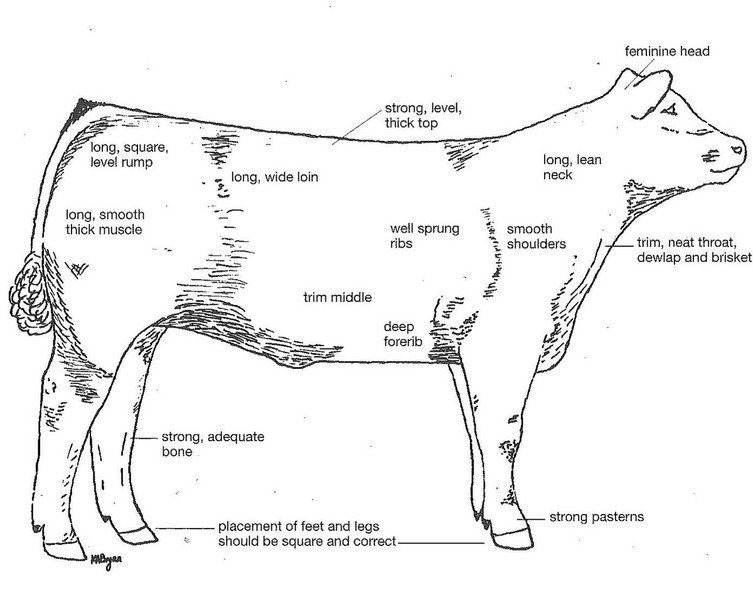
The Ideal Breeding Heifer Poster

"The Ideal Cow"

On the wall in my agriculture classroom of yesteryear hung a poster of "the ideal cow" similar to the image at the top of this post. The ideal cow has a strong, straight top line, doesn't fall off from her hooks to her pins, has a feminine head, isn't post-legged, has strong pasterns, is balanced, and blends well through the shoulders, ribs, and hips, among other things. Those are characteristics of the ideal cow.

There's one other very important characteristic of the ideal cow…

…she's not in your pasture and she's not for sale. The only place you can find her is on that poster in the classroom. Every real cow in the real world is an imperfect reality that is juxtaposed against all of our idealized abstractions.

Somewhere in Heaven there's a poster of the ideal family of churches. They are united in biblical orthodoxy (what they believe) from the start to the end of their statements of faith. Likewise, in their orthopraxy (what they do), they are faithful and pure, and consistently so. They have a zeal for the gospel and for their love for one another. They do not shrink back from correction of one another in the unlikely occasion that it is needed, but they never offer that correction in anything other than a humble acknowledgement of their own failures and a gentle eagerness to maintain the unity of the Spirit in the bond of peace. And when those occasions come, the churches that have fallen are quick to repent and are thankful for fraternal correction. Together they proclaim the unadulterated gospel of Jesus Christ, winning the lost to Christ and planting healthy churches like themselves, all while making sure to baptize them and to teach them all that Christ has commanded them.

Down here, there are no denominations like that. There are no churches like that. There are only imperfect realities juxtaposed against the idealized abstraction toward which we are striving and for which we are yearning.

That's not to equivocate. Not all churches and not all families of churches are equally close to the ideal. Not all churches are even making the attempt with equal effort. Some churches and some denominations are what we might fairly call apostate churches whose lampstands were long ago removed. There are differences, and the differences matter. But it is nonetheless worthwhile to acknowledge that if your favorite sport is criticizing the bride of Christ, you're going to be able to rack up some points, no matter which group of local churches you make your target.

All that just to say this: There are criticisms made of the Southern Baptist Convention and of the local churches who affiliate with her, and they are not all specious. Nevertheless, I believe that the Southern Baptist Convention bears the marks of a family of churches in which the Holy Spirit is still at work refining us, and that gives me hope and reason to stay, even in the light of our failures.

The Criticisms

So, let's look at some of the criticisms that are levied against the Southern Baptist Convention. Let's dare to measure the Southern Baptist Convention against the perfect cooperative structure for churches and see how she fares. Let's look unguardedly at her weaknesses. Let's do so fairly and with compassion.

Criticism 1. The Southern Baptist Convention doesn't manage well the appropriate level of accountability among member churches. Like most of these complaints, this one comes at the SBC from both sides. Some are uncomfortable that the SBC has grown too cavalier in hunting down wayward churches, having yielded too greatly to what I'll call the "root and branch" elements of the messenger body. Others are uncomfortable that the SBC has grown too latitudinarian, or perhaps just too lazy or incompetent, in failing to police vigilantly enough the doctrinal or behavioral variations among its affiliated churches.

Of course, it's more complicated than that. Alongside people who think the SBC is too stringent and people who think the SBC is too lax, there exist a substantial number of people who believe that the SBC is BOTH too stringent AND too lax. They may think that the convention should be quicker to disfellowship churches guilty of racism and sexual abuse and yet less hasty in disfellowshipping churches who call women as pastors and who keep people in membership who are unrepentantly engaged in homosexual sex. They may flip that situation on its head, being skeptical about haste in disfellowshipping those credibly accused of sexual abuse and yet ready to pull the trigger quickly on the church with a female Assistant Pastor to Junior High Girls.

What all of these positions share in common is an idea that the Southern Baptist Convention has a responsibility to hold local churches accountable to a standard of friendly cooperation alongside a responsibility to defer to the autonomy of local churches, that they know how to balance those two realities, and that the Convention isn't measuring up in this area.

Criticism 2. The Southern Baptist Convention doesn't practice enough transparency to ward off corruption or to discharge its duties to churches in friendly cooperation with the Convention. Sometimes this concern is offered regarding salary structures at entities. Sometimes it is connected with calls for independent audits of the various entities. Sometimes it isn't necessarily connected with financial transparency, but is related to calls for greater and more detailed communication. This year's motion to explore structures for greater independence for Baptist Press would be an example of a call for greater transparency, in a way, seeking the opportunity for enhanced neutrality in the reporting of Convention-related news.

At its best, this criticism is rooted in a concern that messengers may not make the best decisions if they do not have the best information. Transparency, in such a case, is an important prerequisite for proper SBC governance. In this vein, sometimes the concern is that even SBC trustees are not the beneficiaries of sufficient transparency to do their jobs well—not every person calling for transparency is calling for tell-all exposés. At its worst, this criticism can be an element of conspiracy theories and allegations that are not well founded in credible sources (one trivial example: the allegation that B.H. Carroll's portrait at SWBTS formerly contained a cigar, but that anti-tobacco prudes had it painted out and covered up the story).

Separately, I should mention that cover-ups and other mishandling of sexual abuse that has happened in Southern Baptist churches have become an area of major concern when it comes to the need for transparency in the Convention.

Criticism 3. The Southern Baptist Convention has inappropriately devolved into an oligarchy, and the common people in the churches to whom the Convention apparatus should be accountable have lost their voices. Whether you call it the "elites," the "platform," or the "smoke-filled room," this criticism suggests that messenger governance at the Annual Meeting is a façade and that the Convention is actually under the control of a small group of powerful people.

This criticism is actually made by people on all sorts of different sides. The emergence of the Conservative Baptist Network (CBN) included the organizational involvement, undisclosed at first, of key SBCEC leadership like Mike Stone, and although it was denied for quite some time, eventually Paige Patterson acknowledged that the introductory videos were shot in his Parker, TX, home. Consequently, some people have portrayed the CBN as a group of disaffected power-brokers trying to control the Convention in opposition to the will of a messenger body over which they have lost control. Others have traced the movement of people formerly connected to Southern Baptist Theological Seminary into key positions of influence at SBC entities and have claimed that Dr. Mohler is the "Godfather" of the SBC, maintaining control from Louisville. Still others have pointed to Danny Akin, Russell Moore, JD Greear, Kevin Ezell, et al, and have found in them the true power-brokers of the SBC.

One related idea that deserves separate mention is the idea that the messenger body themselves are the "elites" and the "platform," and that the expense and difficulty of participation in the Annual Meeting shuts out any opportunity for the real rank-and-file of the SBC to influence decision-making.

Common in all of these perspectives is the idea that the rank-and-file Southern Baptists—curiously always understood to agree with the speaker—have been deprived of their rights to decide the direction of the Southern Baptist Convention. As a result, one hears, the Convention is being led to take positions that are antithetical to the interests of the common Southern Baptist.

Conclusion

I believe that the major criticisms that give rise to people's interest in leading their churches out of the Southern Baptist Convention have been mentioned in this article. But I want to make certain that the ensuing articles "scratch where it itches." With that in mind, can you think of major complaints, widely held, that are unrepresented here? Leave a comment or send a tweet or post if anything comes to mind.

Starting with the next post, I will begin to address these issues and demonstrate why I believe that, notwithstanding these complaints, continued participation in the Southern Baptist Convention is good for your church (if you match up with the criteria I have mentioned in the first post in this series). Also, I hope to show that, when you compare the SBC with your other available real-world options (instead of just comparing her against the "ideal cow"), there's a strong case for leaning in 100% to cooperation through the SBC and the Cooperative Program. This is true, I think, even given the fact that there are always VALID criticisms that can be lodged against the SBC.

Sunday, July 24, 2022

Why the SBC Is Worth It

Kate Shellnutt at Christianity Today was the reporter who surprised me, and herself, with a question that touched upon my most profound personal thoughts about being elected as President of the Southern Baptist Convention (skip to 19:05 in the interview below).

In particular, I want to expand upon one statement that I made: "Every way that I've served Southern Baptists has left scars—every way that I've done it—but this family of churches is worth it." I have no desire to elaborate upon the scars, but I do want to take a few moments to talk about why the SBC is valuable to individual pastors, to member churches, and to the world outside the Southern Baptist Convention.

Why This Message Is Timely

It always matters to speak to the value of the SBC, because since the formation of this family of churches, there has never been a moment when there were not some individuals and churches contemplating departure from the Convention. Churches left to join the new Campbellite movement (which later became the Church of Christ denomination), the anti-missions ("hardshell") movement, T.P. Crawford's "Gospel Missions" movement, the "associational Baptist" denominations (the BMAA and the ABA), the Independent Baptists, the Cooperative Baptist Fellowship, and a dozen other assorted destinations.

This moment in time is no different. Well-known Southern Baptists like Russell Moore and Beth Moore (unrelated) have recently left the Southern Baptist Convention, and their departures have received a significant amount of attention. Their departures were attributed to the idea that the Southern Baptist Convention is too strict, too dour, too hostile, too beholden to the politics of the far-Right in America, and too corrupt. Other Southern Baptists like Josh Buice have led their churches to depart from the Southern Baptist Convention because it is too lax, too winsome, too accommodating, too behloding to the politics of the far-Left in America, and too corrupt. Are these people looking at the same family of churches? They are, and they are all sincere in their observations, just as most of those who have left the SBC since 1845 have been.

Some people will no doubt point out that none of these departures have managed, over the course of nearly 185 years, to scuttle the ship of the SBC. Indeed, Southern Baptists have, by many measures, fared far better than any of the other outlets preferred by the departees. Right now, even in the midst of some controversy, Cooperatieve Program giving is strong and strengthening (although the nation's economic indicators are ominous). Sometimes in our history, the departures have arguably been the very cause of seasons of significant growth and improved effectiveness for Southern Baptists—controversy can be costly and distracting. Considering all of this evidence, some people might say, "Why argue the value of the SBC to those who want to leave?" Because there is always somewhere else to go, and because churches' decisions about affiliation with other churches should always be based upon the best way for those churches to pursue the Great Commission, those who see the value of the Southern Baptist Convention should never cease making the case for cooperation within this fellowship of churches.

Toward that end, over the next few days, I am going to be authoring a series of blog articles making the case for why affiliation with the churches of the Southern Baptist Convention is a reasonable and valuable partnership for your church. That is, the reasons I will be giving in this series of posts are reasons why your church should stay in the SBC.

But, Should Your Church Stay?

Well, hold on a minute. I don't know for sure that your church should stay, because a lot of people could be reading this post from a lot of different sorts of churches. The Southern Baptist Convention is a wonderful fellowship of churches, but it is not the right place for every church. Whether you belong here depends upon your church's theology, mission, and temperament.

If your church's theology fits within The Baptist Faith & Message, you can know for certain that you have a theological home in the Southern Baptist Convention. Our statement of faith is in some places deliberately precise and in some places deliberately vague. I grew up across the street from a godly Methodist woman. She was a blessing to me. She didn't belong in the Southern Baptist Convention. I attended school with a good friend who wound up serving in Anabaptist and Methodist churches because he did not belong in the Southern Baptist Convention. I received a congratulatory message after my recent election from a well-known Presbyterian. He does not belong in the Southern Baptist Convention. Sometimes, to say that a church does not belong in the Southern Baptist Convention is not an attempt to defame or insult anyone, or even an attempt to break personal fellowship with them; it's just an honest effort to describe them and seek a good ecclesiological home for them. Southern Baptist churches have in common some shared theological convictions that define boundaries for our cooperation and affiliation with one another.

If your church's mission includes cooperating with other churches to fund and otherwise support a variety of activities—activities that make all of our churches more effective in our Great-Commission work—then you can know for certain that you have a missiological home in the Southern Baptist Convention. Several of the departures that I mentioned above in this essay (for example, T.P. Crawford's "Gospel Missions" movement) involved people who shared the Convention's general theological beliefs but who did NOT think that individual local churches should cooperate with one another in quite the Southern Baptist way to send missionaries, train pastors, print Bibles, respond to disasters, or some of the other dozens of things that Southern Baptists cooperate with one another to do. Understand, they thought all of those things should be done, but they disagreed with the idea that multiple local churches could form a structure like the SBC through which to do it. Most Baptist churches have not had any qualms about cooperating in this way, but if your church does, you likely should not be affiliated with the Southern Baptist Convention.

If your church's temperament is one of cooperation, then the Southern Baptist Convention is a good fit for the personality of your church. Some churches or believers just don't want to see value in other churches, other ministries, other pastors, and other believers as potential partners for gospel work. I'm reminded of what a family friend once said: "I've decided to become an Independent Baptist, and the first thing I've decided to be independent from is other Independent Baptists." There are people like that—good people sometimes—who just place a very low value on the idea of cooperation with other believers or churches who don't dot all their 'i's and cross all their 't's just the same way. Some of my readers will be familiar with the idea of secondary separation, often applied to minor doctrines, that have marked some of the more stringent Independent Baptist churches. This idea of separation, however, is not the exclusive property of groups like the Independent Baptists; sometimes the theological Left, especially in more strident forms of contemporary "cancel culture," can have its own disassociative strictures. If you or your church has a long list of doctrines or political positions that would mandate something like secondary separation, you're probably going to be happier somewhere other than the SBC.

But that's likely not most of you who are reading this essay. For you, the conservative, missions-minded Baptist in a church who can affirm The Baptist Faith & Message, I hope you'll find the forthcoming series of articles helpful.

Wednesday, May 25, 2022

Response to the Sexual Abuse Task Force Report

Bart Barber
May 25, 2022
For Immediate Release

I have now read the complete text and the appendices of the May 15, 2022, document from Guidepost Solutions entitled, “Report of the Independent Investigation: The Southern Baptist Convention Executive Committee’s Response to Sexual Abuse Allegations and an Audit of the Procedures and Actions of the Credentials Committee.”

The record represented in this report is clear. Men and women, boys and girls, have been abused in Southern Baptist churches. The churches belong to Jesus Christ, their Founder and Head. Every time abuse happens in a church, the abuser has committed a mutiny against Christ’s lordship over the church and has scandalized His little ones. Jesus said that it would be better for such a one to have a millstone hung around his neck and to be thrown into the sea (Matthew 18:6).

Sometimes the victims of that abuse or sometimes the leaders of those churches have called the Executive Committee of the Southern Baptist Convention to seek advice or to try to protect other churches from enduring the same abuse at the hands of the same abusers. Each of these contacts has presented the Executive Committee with an opportunity to help those churches and those individuals as much as possible. Instead, some people entrusted with leadership at that entity have deliberately helped as little as possible—deliberately refusing to return phone calls and messages, deliberately withholding information that they were collecting about abusers, and deliberately minimizing the amount of helpful advice that they would disclose.

How did it come to this? The report demonstrates very well that these bad decisions arose out of a fundamental misunderstanding of the distinctive Baptist belief in the autonomy of the local church.

Unlike some denominations, Baptists believe that every pastor in every local church is also an elder and a bishop. We recognize no biblical office with any authority over multiple local congregations. Our churches enter voluntarily into association with one another, but they cede none of their God-given authority to these associations or to any of the other churches with which they are affiliated. They call their own pastors; they own their own properties; they set their own doctrine; they direct their own finances. This is a biblical doctrine that Baptists have followed and cherished since the 1600s. Like all our doctrines, it certainly can have legal implications, particularly when attempts are made to hold some churches accountable for the misdeeds of other churches. It is, nevertheless, a theological concept, not a legal device.

The Executive Committee seems to have been operating under a different notion of local church autonomy—one arising less out of the Bible and more out of Blackstone.1 The biblical doctrine of local church autonomy in no way prevents churches from advising one another, critiquing one another, or establishing or withdrawing fellowship from one another. Yet, although these activities in no way endangered the biblical doctrine of local church autonomy, the Executive Committee’s counsel believed that these activities posed a threat to the Executive Committee’s legal arguments against ascending liability. The biblical doctrine of local church autonomy came to be conflated with that legal argument, although they are not the same thing.

The waiver of attorney-client privilege has proven to be indispensable in enabling the report to show us this doctrinal failure. It is only in the released memoranda and emails between Executive Committee staff and the Executive Committee’s legal counsel that we have been able to read for ourselves this doctrinal misunderstanding—in at least some cases, what seems to have risen to the level of doctrinal misrepresentation—that has led us so far astray.

Southern Baptists need to reassert a proper biblical understanding of local church autonomy.

  • We can affirm local church autonomy while telling the truth about survivors like Jennifer Lyell.
  • We can affirm local church autonomy while responding to the correspondence and respecting the advice of survivors like Christa Brown.
  • We can affirm local church autonomy while disfellowshipping congregations who give standing ovations to or persist in employing those who have abused survivors like Jules Woodson or Dave Pittman.
  • We can affirm local church autonomy while allowing survivors like Rachael Denhollander to speak the truth to us without censorship.
  • We can affirm local church autonomy while putting in place a robust process for determining the truth about allegations that member churches have dealt recklessly with cases of sexual abuse and then taking action upon the truth that we discover.

What’s more, although I am not a lawyer, I think we can do all these things and more without plunging headlong into some legal connectionalism that nullifies all the legal protections that arise out of our sincerely held beliefs about local church autonomy.

In conclusion, this much is certain: The same Bible that teaches us about local church autonomy teaches us more clearly and forcefully about loving one another. The words and actions described in this report are in many cases far removed from love for survivors and for their advocates. What’s more, the ways that we have walked past survivors on the streets and sidewalks and walked into our meetings without stopping to hear what they had to say has not been an act of love. Guilt for that failure reaches far beyond the C-suite at the Baptist Building. It reaches to me. I wish that I had listened more quickly and more carefully. I am sorry.

Sometimes our assertions of local church autonomy have seemed insincere to the people on the receiving end of them. Do we want people to take seriously what we say about local church autonomy? Then we should demonstrate with actions our commitment to love them to the fullest extent and seek justice for them to the fullest extent that we can achieve within our beliefs.

Regardless of whether I am elected as president of the Southern Baptist Convention, I pledge my efforts toward that end.

Notes

1 "Blackstone" is a famous legal reference work.

Friday, October 8, 2021

Impatient Idealism

What Is Impatient Idealism?

I'm labeling as "Impatient Idealism" something that I think is part of the Zeitgeist. It arises out of some understandable and at least partially good motives. It may yet work some good among us. It is already working some bad.

By "idealism" I don't mean philosophical idealism. Rather, I mean the common use of the word to describe a vision of a "right way" for things to be or happen, perhaps even a right way that has never before been realized, combined with a determination not to settle for less than the achievement of that vision. Idealism, I think, is on the rise.

Both the Internet and the progressive age that has delivered the Internet are causes, I think. Not "progressive" as a political label, but rather "progressive" to describe a time in which human beings are inventing a lot of things, solving a lot of problems, and making a lot of changes that are, for the moment, broadly perceived as positive changes. The Internet is both one of the things that we have invented and a vehicle for the delivery of a lot of other invented things. Because of it, you have a lot less obligation now than existed 50 years ago to have to wrap your life around someone else's "right way" of doing things. You bank when you want to by way of your phone, so that almost no one complains of "bankers' hours" any longer. Burger King's "Have It Your Way" advertising campaign from the 70s was just about customizing your condiments—now you can order your fast food on an app and have it brought out to your car when you arrive.

Social media is perhaps the quintessence of ordering your life around your "right way" preferences. It watches you carefully, and then it gives you the facts that line up with your thinking, the friends who line up with your thinking, and the products that line up with your thinking. You can order so much of your online life around your own ideals.

And in general, I think that can be a good thing. Idealism is better than base pragmatism. We should have ideas that solidify into convictions. We should live with those convictions as guardrails to keep us on the right path when pragmatic concerns would make us something other than what we ought to be. I'm for more idealism.

By "impatient" I mean…OK, I just mean exactly what I wrote. The principal target of our impatience is the government. No political campaign can be successful if it is not based upon ideals; yet, the quickest pathway to success in governing after winning the campaign is pragmatism. There is an inherent tension. Dancing that dance can be a formula for short-term success, just like MasterCard can be a formula for short-term prosperity. But voters and banks alike eventually grow impatient with unfulfilled promises.

And in general, I think that can be a good thing. Unending patience with regard to important ideals is dereliction of duty. In many ways, it is the impatient who get important things done.

Two Examples of Impatient Idealism

Two movements that exemplify Impatient Idealism, each of them external to the actual work of the Southern Baptist Convention, made an appearance at the 2020 Annual Meeting. I'm talking about, Critical Race Theory & Intersectionality on the left and Abortion Abolitionism on the right.

The ideal that the innocent life of babies should be protected by law even before they are born is a compelling one. The zeal to deliver actual results in the pro-life movement at the national level has been decidedly secondary to other concerns. Ronald Reagan, George W. Bush, and Donald Trump all delivered on tax cuts. They all delivered on increased military spending. None of them delivered on abolishing abortion, although they all courted the pro-life vote by appealing to our ideals during their campaigns.

It's high time to be impatient about this.

Folks in the Abolition Movement have risen to that moment. They have an ideal (abolishing abortion) and they are impatient about achieving that ideal. EVERYONE in the pro-life movement shares that ideal (or else they aren't pro-life), but pro-life complacency and willingness to settle are certainly a real thing. To the degree that the abolition movement turns up the heat on our impatience about this ideal it will be a good thing.

Speaking of abolition, the zeal to deliver equal protection under the law to black Americans began in earnest with the work of the nineteenth-century abolitionists like Frederick Douglass and William Lloyd Garrison. It has progressed throughout the long saga of the War Between the States; the Emancipation Proclamation; the Thirteenth, Fourteenth, and Fifteenth Amendments; and the Civil Rights Movement. And yet, after all of that, there are still unachieved "firsts" for Black Americans, and the widespread testimony of Black Americans is that they still experience the institutions of American society differently than do White Americans.

Black Americans have consistently voted for Democrats as a part of a trend that started in the 1930s and reached a crescendo under Lyndon Baines Johnson. The "War on Poverty" among Black Americans has not delivered the results that the politicians promised. Many of the cities that experienced Black Lives Matter protests were led by Democratic mayors and Democratic police chiefs. Minneapolis, MN, hasn't had a Republican mayor since 1973, and that one only served in office for one day. Black Americans have been underserved by Democratic politics.

Of course, some Republicans have been saying that for a long time, hoping that Black people would come on back home to the GOP, but in academia, the more prevalent movement has been to reject the classically liberal foundations of American justice and the American Republic altogether. Having worked through "the system" for more than a century—constitutional amendments, civil lawsuits, legislative victories, etc.—Critical Race Theory has emerged to call into question the very underpinnings of the system and to demand radical changes if Black Americans want finally to achieve equal protection under the law.

That ideal—equal protection under the law regardless of race—is a good thing. It is an unachieved ideal, if considered in its pure and undiluted form. And after all of these generations, Black Americans are well justified in their impatience.

Where Impatient Idealism Goes Awry

I subscribe neither to Abortion Abolitionism (as a movement) nor to Critical Race Theory. And yet I affirm for both of these both their ideals and their impatience? What does that look like for me, and why is it reasonable?

Impatient Idealism is great, so long as the idealism is broadly held and the impatience is tempered by at least a modicum of pragmatic feasibility.

By "broadly held," I mean that idealism should extend to more than just one ideal and to ideals in more than just one category. Prioritization is fine, but totalizing is suspect.

Looking at the Abortion Abolition Movement, although I share the ideal of protecting unborn life, the goal of abolishing abortion, and the impatience with those who have promised far more than they have delivered, some of the specific strategic positions that have come to be part of the Abolition Movement confict with other ideals of mine.

I do not believe that there is any constitutional right to an abortion. It's not in the text of the constitution. It's not in the text of any of the amendments. It wasn't demonstrably on the minds of any of the people involved in drafting any of those documents. It wasn't in the minds of we the people when we ratified them. There is no constitutional right to an abortion. There is just a Supreme Court case inventing the fiction that there is a constitutional right to an abortion.

For at least a significant portion of the leaders in the Abolition Movement, the movement advocates nullification. You might remember a "Nullfication Crisis" from your history classes once upon a time. Nullification is the idea that individual states can simply invalidate Federal actions of which they disapprove. The Abolition Movement wants individual states to nullify Roe v Wade—to declare it not to be law in Texas and to govern contrary to its findings. Andrew Jackson nearly went to war over this idea.

I do not believe that there is a constitutional right to an abortion, but I do not believe that the answer to the abortion crisis is to make constitutional rights something (contrary to the Fourteenth Amendment) that individual states can nullify. Should states be able to nullify our First Amendment rights? Our Second Amendment rights? Alongside our shared ideal that the law should protect unborn infants stands (for me) my ideal that we should respect the rule of law and that we should acknowledge unalienable rights as…well…just as unalienable by the several states as they are by the Federal government.

The answer to the question of abortion is the overturn of Roe, not nullification. Our idealism should extend to not wanting Civil War and not wanting disposable rights under potentially despotic regimes as well as to the rights unborn babies have to life. Broadly held idealism.

The Abolition Movement, in my opinion, totalizes our ideals against abortion and jettisons other important ideals where they provoke tension with our impatience over this one.

Critical Race Theorists rightly observe that we have failed to live up to the ideals of freedom and justice that we have articulated. Martin Luther King, Jr. was especially gifted at pointing out the divergence between what Americans said about our ideals on the one hand and how we were treating our Black fellow citizens on the other hand.

But instead of saying that racism in America has amounted to a failure to live up to American ideals articulated in the Declaration of Independence and in our Constitution, Critical Race Theory suggests (or even outright asserts) that those documents and those ideals are flawed and incapable of achieving racial justice.

CRT, if I understand it correctly, is a call to seek to achieve equal justice under the law for Black Americans by abandoning the very ideals that made me desire that equal protection in the first place. CRT alleges that the Constitution is racist (not just the 3/5 Compromise, but the gist of the document itself and the system it established and perpetuates). Key ideas that lie behind and appear within the Constitution, such as the idea that people should get the same treatment at the hands of the law regardless of race, are singled out as part of the problem. Instead, Critical Race Theorists explicitly call for the law to treat people differently according to groups (akin to Affirmative Action, but applied beyond hiring to address law enforcement, for example).

The American ideals of justice arise significantly out of a biblical Judeo-Christian idea of justice. I cannot walk away from them. And there's no need to do so. Apart from CRT/I, Americans can share the very approach that MLK took by affirming the American tradition of law and justice and calling us to live up to our ideals.

For both of these movements, there's also a dire need to take notice of a little pragmatism. One wants to ask Critical Race Theorists whether their theories have been implemented successfully in ways that have achieved a civilization better for its minority populations than has the American experiment, our flaws and failures acknowledged and notwithstanding. One wants to ask the Abolition Movement whether the retrenchment of racial codes in the South after the Civil War and the realities of the segregated states a full century later really commend to us the path of impatient nullification and potential armed conflict as ways to achieve what we desire?

I'd call us to more (broadly held) idealism, not less of it. And I'd call us to the level of impatience that keeps the process moving, but since patience is a fruit of the Spirit, I'd call us to retain enough patience not to jump out of the process and burn it down.

Note: The Southern Baptist Convention has rejected Critical Race Theory and has adopted a resolution affirming a form of the Abolitionist Movement. I respect the voice of the messengers in both cases, and I'm more comfortable with the latter resolution after it was substantially amended from the floor.

Wednesday, June 16, 2021

Rescuing Resolutions

This week I have encountered at the SBC Annual Meeting (not for the first time) the idea that the Southern Baptist Convention ought to do away entirely with the resolutions process. The sentiment is widely held, deeply held, and rationally held. The underlying rationale, if I might summarize, is that the resolutions process accomplishes nothing other than causing trouble.

I've decided tonight to offer an alternative point of view that I hope everyone will consider. Here's my outline. First, I want to spell out some valuable things that I think our resolutions process contributes to our convention. Second, I'd like to propose some etiquette that, applied to our resolutions process, could help it not to be so troublesome.

Things Resolutions Accomplish

I believe that the resolutions process accomplishes some worthwhile things. Indeed, to go even further, I think that there are some ways that the Convention would suffer from the absence of the resolutions process. What's more, I think that having a Committee on Resolutions to process the resolutions that we make is the best way to navigate this process.

Pro-Resolutions

First, resolutions provide a means for our convention to create messaging about things like the Equality Act, and that's something that we need to do. The Equality Act endangers the entire American experiment in religious liberty. Southern Baptista and Southern Baptist institutions will approach national and state legislators, executives, and bureaucrats with the resolution that we passed yesterday and will employ it both in the effort to prevent passage of the Equality Act and to challenge it in the courts if it does happen to become law. Perhaps you believe that Southern Baptists can accomplish this goal some way other than through the resolutions process, but you can't say that the resolutions process doesn't accomplish anything. It accomplishes this.

Second, resolutions provide a point of engagement for Southern Baptists in the Convention's deliberative process and empowers individual Southern Baptists to have their voices heard. It's easy for entity heads to have their voices heard. It's easy for high-ranking entity employees to have their voices heard. It's easy for trustees and committee members to have their voices heard. It's easy for very influential pastors to have their voices heard. But it's not easy at all for most of our pastors and for almost all of our laypeople to have their voices heard. I've got to say that a lot of the people I hear wanting to eliminate the resolutions process are in one of those categories that don't need the resolutions process in order to be heard. Honestly, I don't always like what I hear when I hear all of the voices of the SBC, but neither do I like closing all of the doors for people to speak up. Yes, some resolutions may not pertain much to the core mission of the Convention, but a lot of them do. It is good for our process to provide a way for people to speak about those things, and deprived of that, people will grow frustrated, or perhaps worse, ambivalent. Sometimes people leave because they've been engaged and they've wound up being offended. I think we lose more churches from disengagement than from disappointed engagement, though.

Third, the existence of the resolutions process declutters the motions process. Right now, we can refuse to accept motions that are really just resolutions disguised as motions. Eliminate the resolutions process, and the same sorts of things will just start showing up as motions. That's not a better solution. And if you both eliminate the resolutions process and disallow the making of resolution-type motions from the floor, the message to the messengers is that we expect them just to shut up and keep sending those checks. That's not good, and it isn't likely to be tolerated for long.

Pro-Committee-on-Resolutions

Of course, we could keep resolutions but abandon our current committee process for receiving, reading, reviewing, and recommending them. I think that's not a good solution. The committee is helpful for the following reasons.

First, the committee process requires that resolutions be submitted in advance. By imposing a timetable, this process tends to favor resolutions coming from people who care enough about their subject matter to work in advance and who are well enough organized to meet a deadline. That improves the quality of the resolutions that come before the convention.

Second, the committee process offers the opportunity to consolidate similar resolutions, vet them, and prioritize them. As a member of this year's committee, I read every submitted resolution for 2021 multiple times. You don't want to do that.

Third, the committee process offers the opportunity to improve resolutions. You don't have to be an English Composition major to have a great idea for a resolution. Sometimes very good resolutions need a little editing to turn into great resolutions. With the current committee process, messengers only see resolutions in their very best state, as far as form and style go.

Proposed Resolution Etiquette

I do think there are a few things we could do that would make our resolutions process more productive and efficient and would make fewer people hate it. These aren't rules. I'm not proposing any further rules that would handcuff the messengers. I'm just proposing what I think are some needed principles of resolution etiquette.

First, let's try only to bring out resolutions that the broad swath of our messengers either already understand or can come to understand quickly. To pull a few examples from the 2021 process, our resolution "On the Sufficiency of Scripture for Race and Racial Reconciliation" touched upon topics that Southern Baptists have discussed at length for two years. Our messenger body knew what they thought about this. The resolution on "The Equality Act" touched upon pending legislation that messengers may or may not have already studied, but there are things that the messengers DID already know—about the developing conflict between LGBTQ advocates ahd religious liberty—that made it likely that any messengers who did not already know about the Equality Act would be able to understand pretty quickly just from reading the resolution what was afoot. The resolution "On Sole Membership," touched upon a topic that the messengers were not likely to understand, but we believed that a quick explanation could inform messengers about this resolution.

Second, if we could vote in favor of a resolution as it stands, let's strongly consider not trying to amend it. Of course, if you could NOT vote in favor of a resolution as it stands, and if a simple amendment could make the resolution supportable for you, then by all means, propose an amendment. Amend resolutions to save them. But if you're just trying the IMPROVE a resolution that is already good enough to earn your vote, as a matter of etiquette, please consider not trying to make any amendments.

My rationale for this is simple. We only have so much time to consider resolutions. Even if we were to double the available time, I'm still not certain that we would have much time left over. We knew this year that some of our resolutions contained content that the messengers were going to need to hash out in floor discussion in order to achieve a consensus. But we spent a significant amount of time on resolutions for which we probably all had agreement. These days, EVERY resolution seems to be the target of some sort of amendment. We've all got the RIGHT to do that, but here's how it's a question of etiquette: Is my proposed friendly amendment so important that my neighbors should be deprived of time to ask their questions about genuinely controversial resolution topics? In general, if I can live with it the way it is worded, I should.

Third, your default vote should be a "Nay" until the resolution earns your "Aye." Don't treat the committee as infallible; hold the committee accountable. You don't owe the committee your unwavering allegiance, and any committee who expects that the messengers should uphold them at every point is being unreasonable. If you are consistent about this, and if the committee knows that the bar is going to be high, then the committee is likely to be more careful about the resolutions that it proposes.

Fourth, if you would be a resolution-writer, be prepared to submit your resolution multiple years. You engaged in the process. You wrote a resolution. It was beautiful. It was truth. I wanted it to succeed. But we only have a two-day convention, and we only have so much time for considering resolutions. We have to prioritize. Some resolutions we have to leave to the side. That doesn't mean that we didn't like your resolution. You should submit it again next year, when the volume of submitted resolutions may not be so high and the number of unavoidable topics may not be so imposing. Commit to a plan of patience, giving more than one committee the chance to consider your proposed resolution.

Fifth, avoid booing and catcalls. It'd be different if we were Pentecostals, perhaps, but it's just unseemly for you to be so reserved in your worship and then so vocal, active, and energetic in your disparagement of those who disagree with you.

Conclusion

Our resolutions give us a way to have a little release valve for our sentiments. They give us a way to let any and every church say something through the convention. They are needed. But we can still make them better. What other suggestions would you make? There is hope for the resolutions process, and I think we should do what we can to strengthen it.

Friday, February 26, 2021

Jim's Adoption Story

The material below was originally published on a personal website. I am reposting it here today in honor of Jim's 18th birthday. Happy birthday, son. It's been an amazing blessing, with many more on the horizon.

The Calm Before the Storm

My last semester of Ph.D. seminars was just underway. All of my seminars met on Thursdays, so every week I drove to Fort Worth on Thursday morning, spent the day in seminars, spent the night at the seminary hotel & conference center, and spent Fridays in the library before driving home. This particular week was an exception. Tracy had enrolled in a conference for ministers' wives at the same conference center that was my weekly home-away-from-home. We booked a room for Thursday and Friday nights (February 20-21, 2003).

It was a good weekend. I was preparing a research paper concerning revivals that occurred in the Confederate Army during the War Between the States. Tracy was attending her conference. We scheduled to meet a friend (Keith Sanders) and his fiancée (Melissa) in Grapevine on Saturday afternoon, February 22, to watch Gods and Generals. We stayed throughout this rather long movie and then began our drive home.

During the entire trip we never bothered to check our home answering machine.

Panic!

The light was flashing on the answering machine as we walked in the door. Oh well, nothing was new about that. We decided to finish unloading our luggage from the car and deal with the messages afterward.

At the first words of the first message we began to panic. A call from Dr. Shirolyn Moffett in Harrison, Arkansas, could mean one thing and one thing only: a baby. Six messages were on the machine; five were from Dr. Moffett's office. The calls had begun on Thursday, our first day away.

Oh no! They had been calling for over forty-eight hours! By now they certainly had moved to their next prospect family. We had neglected to check our messages, and consequently we were certain that we had lost our opportunity to adopt.

Of course, we decided to call Arkansas immediately just on the chance that Dr. Moffett was still waiting for us. To our surprise and delight, she was. She had received one of our fliers a year earlier, had kept it in her files for the entire interval, and had called us immediately when she encountered an adoptable baby. She made call after call that weekend, but she was determined to hear from us before following any other leads.

Delirium

What we learned thrilled us. A baby boy was on the way. For very good reasons arising out of her loving concern for the children she already had, the mother had decided to place him for adoption. Would we be interested? Absolutely! But we needed to be ready on a moment's notice, because this baby was due to arrive at any time.

Fortunately, we were ready. We had already completed a home study and criminal background check in preparation for another potential adoption that had not materialized. Dr. Moffett promised to give our toll-free telephone number to T--- (our birth-mother), and she called within just a few minutes. The call went well and we were all ready to move forward. Fewer than ten telephone calls put this potential adoption in motion.

We tried to keep our emotions in check, because we had been this far in the process before. Nevertheless, the weekend seemed to drag along as we kept our powerful secret to ourselves and waited on pins and needles for a call from Arkansas.

"Oh, the Weather Outside Is Frightful"

As you can imagine, we did not spend much of the next two days watching the television. So much remained for us to do. We burned up the telephone lines between our lawyers, our families, our friends, and ourselves. We also began the frantic provisioning process. We already owned a car seat and a few basic supplies, but we had expected more than a shopping day or two to prepare for a baby.

On Monday, February 24, I went to work. Between church-related tasks I manned the phone lines for adoption-related telephone calls. We determined that our Texas lawyers would not be necessary: that we could enact the entire adoption through the Arkansas courts without attempting an unwieldy Interstate Compact Agreement.

Tracy was volunteering for Texas Baptist Men Disaster Relief's Temporary Emergency Child Care unit. She had made an appointment to work down at the Dallas headquarters on Monday morning. She went to Dallas for her meeting and then went to pursue that critical shopping list.

If we had been watching the television, we would have heard about the winter weather system that was bearing down upon Texas, Oklahoma, and Arkansas. As it happened, our first clue that Murphy's Law was operating in full force was a report on the radio that freezing precipitation was already falling just to the West of the Dallas-Fort Worth Metroplex. When I heard it, I immediately called Tracy and advised her to drive home ahead of the storm. Tracy arrived home to Farmersville and the weather began to degenerate. Sleet fell all night Monday.

The Clock Is Ticking...The Sleet Is Falling

By Tuesday morning the roads were completely impassible. A thick sheet of ice had blanketed North Texas, Oklahoma, and most of Arkansas. I carefully made my way to the church to check for busted pipes or other winter calamities, but except for that expedition we remained in the house all day. Most of the waiting took place within a few steps of the telephone. For one thing, we were continuing to make legal arrangements. More importantly, we knew that T--- had an appointment with her doctor that day, and we were very anxious to hear how close she was to delivery. Part of us wanted the time to be right away: We couldn't wait! On the other hand, part of us nervously wanted a little more time. The weather was so bad that we didn't know how we could possibly get to Arkansas. The news carried pictures of tractor-trailers stalled on slippery inclines of every Interstate highway in the DFW area. The roadside ditches around Farmersville were littered with automobiles.

When T--- finally called, it was 6:00 PM. She had been to the doctor and had been told to expect labor to begin at any time. She had returned home to collect her things, and she was leaving home to go to the hospital. The race was on. T--- insistently encouraged us to get to Arkansas as quickly as we could. One look outside at the driveway confirmed to me that driving was going to be our last resort.

Because I am a licensed pilot, I decided to explore the possibility of flying. Unfortunately, I was not an instrument-rated pilot, and I did not have access to any airplane equipped with anti-icing measures. A quick call to the Fort Worth Automated Flight Service Station for a weather briefing confirmed for me that we would not be going to Arkansas in any airplane that I was flying. Commercial flights were also out of the question. Every major airport was closed. The whole circumstance was shaping up to be a suitable sequel to Planes, Trains, and Automobiles.

Only one good option remained: Joe Nerwich. Joe is a member of our church and a retired American Airlines pilot. He has over 25,000 flight hours. Joe owns an airplane with ice-prevention equipment. I knew that Joe would be willing to help us, because Joe and Johnnie had become good friends. The problem was that Joe was in Colorado skiing. I knew that he had planned to return home on Tuesday, but with the weather foul both in Colorado and Texas, I wasn't sure whether Joe would hazard the trip.

I called Joe's house, but nobody was home. I called his grown children, but nobody had heard from him. I called his condominium in Colorado, but the manager was not sure whether he had left or had stayed. I called his cell phone, but that was just an act of desperation since I knew that Joe always leaves it off. I had no idea whether Joe was fifteen miles or three states away.

In desperation, I tried something outlandish. I called the Fort Worth Automated Flight Service Station and spoke with one of the pilot briefers. I explained our situation to him, hoping that he would understand why I was troubling him. I knew the tail number of Joe's airplane, having flown in his Merlin with him several times. Confiding that Joe was our only hope of reaching our baby anytime soon, I asked the briefer whether he could look in his computer and confirm for me whether Joe's airplane had flown any kind of flight plan within the past twenty-four hours. With all of the post-911 security nervousness at the FAA, I did not know whether the briefer would be able to give me that information under any circumstances. He put me on hold for a minute. When he returned to the phone he said, "I just spoke with the control tower at McKinney. The airplane you asked about has just landed at McKinney, and the passengers have just left the airport."

I recalled that Neal and Carol Watts, members of our church, had accompanied Joe and Johnnie to Colorado, so I called Neal's cell phone. No answer. After a dozen tries, Neal finally answered the phone. The foursome had gone to eat dinner and had not paid any attention to their phones until the drive home. After a brief conversation, Joe agreed to help us. About ninety minutes had passed since T--- had called. At Joe's house we explored potential flight plans, tried to arrange for ground transportation at our destination in Arkansas, and shared our excitement with Joe and Johnnie. When we finally had everything in place, Joe called the airport to check on the status of the airplane.

Unfortunately, the status of the airplane was poor. The ramp was too slick to tow the airplane into the hangar, so it had been sitting outside for two hours. A light sleet had begun to fall again, and the airplane was covered in ice. McKinney does not have deicing equipment, so we were grounded indefinitely. Joe recommended that we go home, get a good night's sleep, and explore our options in the morning.

Tracy and I were not convinced. We contemplated driving to Northwest Arkansas. Maybe the time had come to consider the last resort after all. The drive back to our house from the Nerwiches' house discouraged us from making the attempt. It appeared unlikely that we would make it any farther than the first big hill that we encountered on the drive. I told Tracy that it would be far better to spend the night in our house in Farmersville, from where we could work on a variety of options in the morning, than to spend the night in our car stranded on the side of the road somewhere in Oklahoma, where we would be completely helpless. She saw the wisdom of staying home, so we went to bed (you notice that I did not say we went to sleep).

Jim's Birthday

Before dawn the next morning we were awake and active. Early morning telephone calls revealed that T--- was indeed in the hospital and was in labor, but that the baby had not yet come. T--- was nervous about whether we would be able to make it in time. I assured her that we were doing every responsible thing to try to get there. We arrived at the Nerwiches' before 6:00 AM. Joe prepared breakfast for us and tried to calm the both of us. A lifelong pilot and the son of two pilots, Joe knew that it is dangerous to approach any kind of flying trip with too much determination to get to the destination. I ate, but Tracy could not bring herself to eat much. After the plates were cleared away, we started our drive to the airport.

The city streets and highways were equally slick! We made the fifteen-mile drive in around thirty minutes, arriving at the airport around 7:00 AM. There was Joe's Merlin, forlorn on the ramp, enshrouded in ice. A few steps on the tarmac confirmed that no piece of equipment would be able to tow the 10,000-pound behemoth from its perch. The ice accretions on the wings and control surfaces meant that the airplane could not possibly fly, but nothing would prevent us from starting the engines and using them to taxi about on the ice. Mobility was an option; the problem was finding somewhere to go that could offer any help.

Early that morning I had called the flight department at Texas Instruments. TI's bases its flight operations out of McKinney, and they had recently built an enormous heated hangar. After learning about our situation, the kind people at TI agreed to let us park the Merlin in their hangar long enough for the ice to melt away from the critical areas. Joe and I drove down to the TI hangar to explore the possibility. The Gulfstream inside looked small for its surroundings, so we knew that the much-smaller Merlin would fit in the hangar. The climate inside was comfortable, so we knew that the ice would melt quickly in such an environment. To our chagrin, we discovered that the previous two days' precipitation had deposited several inches of ice all along the tracks through which the hangar doors slide. The only way we could possibly get the Merlin to the hangar would be to take a shovel and bust up yards and yards of ice. That job alone would have taken the better portion of the day.

The sunrise was revealing a clearing sky, so we determined to return to the terminal and hope for a slight thaw. Although the ambient temperature was solidly below the freezing point, the bright sunlight could warm the aluminum skin of the Merlin to a high enough temperature to melt away the ice. We sat in the terminal and "watched for the pot to boil," so to speak. While we were there, the telephone rang: T--- had given birth at 7:00 AM to a healthy baby boy. He was there! Now T--- and Dr. Moffet wanted to know when we were going to be there. We promised to arrive in Arkansas just as soon as we could.

The sun went to work, and eventually we discovered that the ice's grip on the airplane was loosening. Joe and I went outside and began to hand-pick ice from the lift-producing areas of the airplane. The time was about 10:30 AM. The Fixed Base Operator at the airport was able to get a fuel truck out to the Merlin, and we took on sufficient Jet-A to make the trip with emergency reserves appropriate to the inclement conditions. Joe went inside to check the weather and file a flight plan with the FAA. As he was in the back of the terminal, I noticed a City of McKinney road-grader taking up position on the end of the runway. "Look Joe," I said, "The City is going to clear some of the ice from the runway so we can leave!"

What had delighted me had perturbed Joe. Because I had so much less experience that Joe, I did not realize that the City had just ended our chances of taking off any time soon. Joe's twin-engine airplane could have managed the takeoff from an ice-covered runway. He could maintain directional control with the rudder and by varying the thrust from the two engines until we were safely in the air. What the city was doing changed everything. They were creating a narrow center strip of good traction bounded by piles of loose chuncks of ice and snow. The loose debris was a hazard to the engines and the traction differential between the concrete and the icy patches increased the danger that we would lose directional control on takeoff. We had missed our chance by mere minutes.

We left the airport and went to eat lunch at some point between 11:00 and noon. Tracy and I were two bundles of nerves. What if T--- changed her mind? We had already been through an experience like that once before, and I wasn't sure how well we would cope with another journey down that road. With each passing hour we felt that the risk of losing this baby increased. Deciding to place a baby for adoption is difficult enough as it is; we did not want to complicate T---'s struggle by adding any worries that her baby would be alone in the hospital awaiting our arrival. Lunch was anything but festive.

Finally we returned to the airport. The City still had not finished the runway. Joe and I walked through the biting cold out to the runway to inspect things at close range. Joe determined that the cleared portion of runway, although only a fraction of the total runway length and width, was sufficient for us to depart. Excited finally to be making some progress, the three of us loaded the airplane, started the engines, and taxied along the icy taxiway to end of the freshly-plowed runway. After clearance from the tower, Joe lined up the Merlin and spooled up the big Garrett turboprops. Once he tripped the brakes, we jolted into motion and crossed the numbers. With the end of the plowed furrow growing closer and closer, Joe tugged back on the yoke and we put the frozen ground behind us.

From the copilot's seat I knew that although we had left McKinney, we remained a long way from our scheduled landing at Harrison Regional Airport. After we had bid Texas farewell, I began to tune the Harrison ASOS (Automated Surface Observation System) into the #2 communications radio. Weather was critical at KHRO because only a portion of the ILS (Instrument Landing System) was operational. The electronic glideslope was out of service for maintenance. If it had been working, we could have descended through clouds to as low as 300 feet above the ground. Because it was not working, we could only descend as low as 600 feet above the ground. As we passed over Rich Mountain, the ASOS was reporting a 600-foot ceiling at Harrison: just barely high enough for us to land. The news did not surprise me because the ceilings had been low when we had checked the weather before leaving. The good news was in the forecast, which predicted steadily rising ceilings throughout the day. If the ceilings were legal when we were still more than 100 miles away, surely we would be able to land without event by the time we arrived there.

Have you ever noticed that forecasts aren't always perfectly accurate? By the time Fort Smith passed beneath us, the ceilings at Harrison had dropped to 400 feet. They had lowered to 300 feet after we were well into the Boston Mountains. We shot the approach anyway, hoping that we would catch the one patch of higher clouds during our descent to the field. We reached 600 feet and I looked desperately all around the airplane. There, off the right wing, for one fleeting moment I could make out a car driving along a segment of state highway. My temporary visual contact with the ground was inconsequential: the only thing that mattered was whether the runway environment would come into sight off the nose. Alas, all that lay in front of us was an invariant field of gray.

Joe advanced the throttles and coaxed the Merlin upwards to miss the approach. I turned back to the cabin and looked at Tracy. I had withheld the bad weather reports of the previous minutes from her, hoping that they would come to naught. When I told her that we couldn't land, she looked as though that culminating disappointment would send her over the edge. It was the low point of the day.

We decided to try our luck at Northwest Arkansas Regional Airport, the main passenger airport of the Fayetteville area. The weather was much better there and the landing was anticlimactic. The worry was what to do once we were on the ground. We had arranged for ground transportation in Harrison, some 90 miles away. The FBO courtesy van drove us over the to passenger aviation terminal to browse the car-rental agencies looking for a suitable vehicle to carry us into the icy hills. We obtained a 4-wheel-drive Blazer, transferred our provisions from the Merlin, and began our drive. The time was 4:00 PM. We had been trying to make this journey for twenty-one hours. Jim had been awaiting our arrival for nine hours.

The highways were surprisingly clear. The drive was almost serene but for the intensity of our feelings. Traffic was thick in the Springdale city limits, but once we cleared the metropolitan areas and found ourselves in the open spaces of the Ozarks, we began to move more quickly. As we drove farther, the clouds lowered steadily, reminding us of the foe that had bested us hours earlier. Just before 6:00 PM we entered Harrison. Although we had never been there before, we found the North Arkansas Regional Medical Center easily enough. We burst expectantly into the Labor and Delivery wing precisely at 6:00 PM.

The Much-Anticipated Moment

We knew T---'s room number, so we walked immediately to the door and found it open. We knocked tentatively and Tracy stuck in her head. The room was empty! No birth-mother and no baby! Where were they? We turned to leave and saw a trio of young nurses whose faces were beaming with smiles. "We've got a baby here who doesn't have a name. Can you help us?" Bundled in a mobile crib was 7 lbs., 12 oz., of adorable baby. Tracy confirmed that we were naming him James Dale Barber: James for my Dad, Grandpa, and Great-Grandpa; and Dale for Tracy's Dad. The nurses checked our driver's licenses to verify that we were who we were supposed to be, and then they gave us free rein in the empty hospital room to spend the evening with Jim.

T--- had already left, having waited to meet us as long as she could. Her oldest child had suffered a seizure, and her responsibilities to care for him had already taken her to the Emergency Room with him and then home. Tracy unwrapped Jim and we got our first look at his tiny hands and feet. She sat and rocked him for an hour before conceding to let anyone else (including his Dad) to enjoy the privilege. Hospital policy would not allow us to spend the night there, so we bade Jim farewell for a few hours and went to our rooms in the Holiday Inn Express (you notice I did not say that we went to sleep).

Hurry Up and Wait

Adoption law varies from state to state. Our previous adoption disappointment had been in Texas, where a birth-mother cannot sign a Termination of Parental Rights until at least forty-eight hours after the birth. Our previous birth-mother had changed her mind at more than forty-seven hours. In Arkansas, the waiting period is much longer than forty-eight hours. The adoption remained completely reversible for ten days. Furthermore, until those ten days had passed we did not have permission to leave the state of Arkansas with Jim.

We went back to the hospital at 5:30 AM on Thursday morning. A scheduled meeting with T--- did not occur, but we were able to meet the doctor who made everything possible for our adoption. She arrived and briefed us on Jim's health condition. There was good news and bad news. One of the creases on the palm of Jim's hand was slightly abnormal. In an of itself this feature (called a "simian crease") is totally inconsequential. Three percent of the population at large has this feature, and most of them probably don't know it. The significance of the crease is that it sometimes serves as a "soft sign" of trisomy-21, better known as Down Syndrome. People with DS have 47 instead of 46 chromosomes, the additional chromosome being a third 21st chromosome. The rock-solid 100% way to test for Down Syndrome is to perform a karyotype...that is, to count the number of chromosomes. We ordered the karyotype, but the results did not come in until two weeks later. What a relief it was to learn that Jim was just fine. Since then he has been so healthy and so prone to doing things ahead of schedule that it seems foolish ever to have thought that there was anything wrong with him. Nevertheless, I am glad that we went through our little "scare." God has used it to help me as a pastor to identify with people who are facing tragedies with their children. Also, since we proceeded to adopt Jim while this question was still unanswered, we had an opportunity to affirm our love for Jim as his parents without regard to his health or development.

The good news from Dr. Moffett's examination was her willingness to release Jim from the hospital right away. With the medical release in place, all we needed was a legal release to take Jim out of the hospital. Enter J. Hudson Shepard, Harrison attorney. Our legal arrangements were nuanced. We began the process from Texas by contacting adoption specialist David Cole and Associates of Dallas. We also contacted Arlon Woodruff, a good friend who is an attorney in Arkansas. We imagined that these two offices would be able to handle the intricacies of an interstate adoption. As I mentioned before, we discovered that we could perform the adoption entirely in the Arkansas courts, so the services of David Cole were unnecessary. Cole and Associates gave us this advice and did not charge us a penny. They are first-rate people.

We determined to allow Arlon to take care of the legal work in the adoption, but the weather conspired against him as severely as it did against us. By Thursday Arlon still had not been able to make it to Harrison. He looked in his law directory and found Jerry Shepard for us. Because of the weather, most of the lawyers' offices in Harrison had been closed. Arlon was lucky to find Jerry in his office. Jerry was a wonderful attorney and a delightful person. He had all of the legal paperwork in place within an hour, and we were finally clear to leave Harrison. Joe, Tracy, Jim, and I loaded into the Blazer, drove back to Northwest Arkansas Regional Airport, and flew to Jonesboro, Arkansas to spend the waiting period with Bart's mom, Carolyn (a.k.a., Nana).

A Week (or Better) at Nana's House

The only thing that compares with experiencing a joy is sharing it with people you love. We were so excited to be able to take Jim to meet his family. For the Barber side of the family, necessity scheduled the meeting very early. How exciting it was to arrive in Lake City at the house where I spent my own childhood and youth. We knew that Tracy and Jim would be there for more than a week, but Joe needed to get home, and I also needed to meet the demands of job and school. We all stayed through Saturday, March 1, but on that day Joe and I climbed aboard the airplane and returned to Farmersville.

I preached at FBC Farmersville on March 2, showed up for work at the church office the next week, and then attended my Ph.D. seminars at Southwestern Baptist Theological Seminary in Fort Worth on Thursday. I presented the Confederate Army Revival paper on that Thursday. It could have benefitted from some additional work, but I stayed up all night the night before and eventually ran out of time to add anything else. I had missed all of my seminars the previous week, but all of my professors understood and approved of my priorities. My colleagues and professors all celebrated our good fortune with me.

When the last seminar was complete (at about 4:00 pm), I left the seminary campus. The original plan had been for me to spend the night in Fort Worth and then drive back to Arkansas. So much for plans. After nearly a week away from my wife and baby, I decided that I was going to see them right away. The fact that I had not slept in 36 hours was not going to stand in my way. I drove until midnight and arrived safely in Lake City, thanks to God's protection. Only a little time remained in our nervous period, and we planned to appear in court on Tuesday, March 11.

Adoption Day Arrives

In an earlier paragraph, I began to describe the differences between adoption in Texas and adoption in Arkansas. I only made it as far as the differences in the initial waiting period. In that respect, Texas law is more favorable to adoptive parents than Arkansas law, because it only requires parents to wait forty-eight hours instead of Arkansas's ten days to have some confidence that the adoption is going to proceed. The other contrasts between the two states make Arkansas compare favorably to Texas. Texas requires adoptive parents to make two appearances in court. The first takes place a few days after the birth. At this appearance the court takes legal notice that the birth-parents have terminated their parental rights and installs the adoptive parents as the baby's guardian. The second appearance, some six months down the road, is the formal adoption proceeding, at which point the adoptive parents legally become the baby's parents.

In Arkansas, adoptive parents need only appear in court once. After the ten-day waiting period has passed and the birth-parents have terminated their parental rights, the adoptive parents appear in court for an official adoption proceeding. The court issues an Interlocutory Decree of Adoption. Basically, this document establishes a six-month interlocutory period during which the adoption is reversible in extreme circumstances (for example, if someone could demonstrate that the adoptive parents have attempted to perpetrate a fraud upon the court). After the six months passes, the adoption automatically becomes final without any need for an additional court appearance.

The drive back to Harrison requires between three and four hours. It is a beautiful route through some of the most rustic portions of the Ozarks. Tracy and I decided to make the drive Monday afternoon, stay once again at the Holiday Inn Express, and thereby make certain that no transportation problems or weather problems could prevent us from making our court appointment on Tuesday morning. This was the first time that the three of us were alone together. It was one of the most serene and fulfilling experiences of our lives to slip through the wooded hillsides while Jim slept peacefully in his carseat.

The next morning Arlon, Mom, and Debbie Nunally (a friend from Lake City) drove to Harrison from Lake City and met us at the courthouse. Jerry Shepard was already there. The proceeding took only a few minutes, and long before noon we were back in the car and headed for Texas. We stopped in Fayetteville at the Hoffbrau restuarant and then drove straight through to Farmersville, finally able to cross state boundaries with our new son.

Friends from Farmersville and even Royse City had left us quite a celebrative display in our front yard and had prepared the nursery for immediate use. The ensuing days included visits from friends and family, a spectacular baby shower and celebration at the church, and the joy of learning that parenthood was everything we expected and more. Even when we were childless, God had been very good to us, giving us blessings that many people never know. Now we are doubly blessed. Thank you, Lord!