Republicans have taken it on the chin. The national telephone system has apparently had trouble overnight accommodating all of the Republican candidates who have had to make concession telephone calls. Insider reports from Washington suggest that President Bush has not yet called to offer his congratulations to Osama bin Laden.
Do you know when I first held grave concerns about the outcome of this year's elections? When Bobby Welch announced the results of the 2006 SBC presidential election. It is my thesis that the Southern Baptist Convention is a powerful indicator of the national mood. The Conservative Resurgence began in 1979, at the same time as the Reagan Revolution was emerging in the US. My dissertation regards the same phenomenon in the age of William Jennings Bryan and Arkansas Governor Jeff Davis (not to be confused with Confederate President Jefferson Davis).
The Southern Baptist Convention elected as president a man with a previous public track record of sympathies with liberal views and personalities juxtaposed against a recent retraction of those views and the cultivation of a more conservative public persona. The election of a spate of conservative (for Democrats) Democrats seems to evince a similar thought process. It is almost as though people are yearning for conservatism without conservatives.
I think that such a yearning is doomed for failure. For example, the election of a couple of pro-life Democrats has, by tipping the balance of power to the Democratic Party, done more to set back the pro-life cause in one day than Planned Parenthood, NARAL, and other radical pro-abortionists could accomplish in a decade. What does conservatism without conservatives look like? Liberalism.
Back to my SBC-national politics thesis: The huge, gaping hole, of course, is Bill Clinton. Did anything in SBC life foreshadow the dominance of Bill Clinton?

Showing posts with label SBC 2006 Greensboro. Show all posts
Showing posts with label SBC 2006 Greensboro. Show all posts
Wednesday, November 8, 2006

Monday, June 19, 2006
My Motives Regarding the Cooperative Program
Rzrbk offered a thoughtful comment in response to my Greensboro analysis. With a name like Rzrbk (??razorback??), I'm thinking that he has to be an Arkansan, and therefore a person of impeccable character and high IQ (guess where I'm from). In respect for his comment and because of the length of the response it commands, I have chosen to respond with an entire post rather than just another comment.
The section that most caught my attention addressed the question of my motives behind the comments I made regarding the Cooperative Program amendment both on the floor of the convention and in a post on this blog. I quote from his comment:
I disagree. Trying to understand motives is an important part of historical analysis and contemporary analysis. Without trying to understand motivation, you really can't understand. Discovering motive is more difficult, but not less valid than other kinds of analysis.
So, I think that rzrbk is asking a great set of questions. I hope to answer them.
Fresh out of college, I was recommended to a small church in Oklahoma as the guy to rescue it for the Cooperative Program. The church had just endured a three-way split, and the former pastor had left to start an Independent Baptist church. Before leaving, he had convinced the church to cease entirely its participation in the Cooperative Program. After two years of zealous trying, I got the church to resume partial participation in Southern Baptist missions, but I never got them to give to the CP. Their previous exposure to problems (embezzlement in the construction of something like a retirement village, to hear them tell it) in their state convention had them convinced against the validity of the CP. My convictions in favor of the CP were strong enough that, when I was unable to lead them to participate in the CP, I left. I could not in good conscience pastor a church that would not give through the Cooperative Program.
Today I pastor a church that gives 10% to the CP...sort of. We were giving 10% through the Baptist General Convention of Texas. Now we are halfway along in a move to the Southern Baptists of Texas Convention. Our money is split between two conventions and a small portion is designated to undo some of the things that BGCT is doing. Soon our move will be complete and we will be giving 10% to CP again.
I love the Cooperative Program and am proud to lead a church that faithfully contributes through it.
As an aside, let me mention that I think it is a dubious thing to assign the credit or blame for a church's CP participation exclusively to the pastor. Hey, folks...some of us are still Baptist and practice congregationalism! My church was giving 10% long before I showed up. On the other hand, I've just given an example from my past where I pastored a church giving zip to the CP not because of my leadership, but in spite of it. Yet the entire outcome of the presidential election this year was based upon the notion that Frank Page is responsible for his church's CP giving. What percentage were they giving before he came?
Why not mention 50-50 in the report? Simply do that and I would have been silent. The resolution was no more binding upon state conventions than it was upon local churches. Why not at least mention the 50-50 goal? Especially when the SBC just last year affirmed the 50-50 goal and asked for a timetable of when the state conventions would achieve 50-50? Especially when the report to the convention cited this very report as the answer to the query about when the state conventions estimate that they will achieve 50-50? The SBC asked when the states expect to achieve 50-50, and the answer didn't even mention 50-50!
Why? Because some state convention executives are trying to weasel out of the 50-50 and bury it. I am not making this up. One state convention exec told me from his own lips that the 50-50 split is unreasonable. The SBC messengers asked for a good-faith estimate of when the state conventions would achieve the 50-50 split stipulated at the founding of the CP. The state conventions' answer? Never.
So, my problem is not with the state convention execs being on the committee; it is with their actions on the committee. It would be bad enough to answer "Never" and disavow an ancient promise, yet I would not have spoken out just for that. But the committee went further than that. While turning their backs on their own CP obligations, they laid the blame for flagging CP support upon everyone else. Then they overturned Baptist polity and dared to tell autonomous local churches how much they ought to give. At that, I could not be silent.
I am the only person who mentioned the state conventions in the floor discussion at Greensboro. Two bona-fide members of the "Old Guard" elite, Jack Graham and Jerry Vines, spoke after me, and neither of them brought up this topic.
Nobody prompted or coordinated what I said. The moment I read the Ad-Hoc Committee's original report, I didn't need to hear from anyone in order to know that I disagreed with it. My daily Baptist Press newsfeed reported the basic gist of the report, and I immediately fired off an email to complain to my state executive director. I asked him for contact information to complain further up the chain. He gave me the email addresses of Anthony Jordan and Morris Chapman. I sent them an email to complain. This precipitated a flurry of email conversation among the three of us over the course of the next couple of days.
When the Executive Committee dropped the 10% stipulation, I decided not to say anything at Greensboro. I would prefer a report that specified the 50-50, but I could live with no mention of percentages as a compromise. When an amendment came to reinstate the 10% at Greensboro, I knew that I had to speak to it. I could not remain silent. Surely the nervousness in my voice and the lack of good organization in my comments made it clear to everyone that I had not prepared my remarks in advance.
So, no "Old Guard" was at all involved in my comments.
By the way, I'm a whole lot less impressed with the "New Guard" (who so far have accomplished nothing for the SBC) than with the "Old Guard" (who have a pretty impressive track record). But forgive me for stating my opinion. :-)
So, I am motivated by my passionate love for the CP as envisioned in 1925, including respect for local-church autonomy, strong encouragement for local churches to give sacrificially, and a 50-50 division of CP receipts between in-state and rest-of-the-entire-world expenses.
I don't want just to sit on the sidelines and criticize. I want to be a part of the solution. In putting that solution together, I'm more than willing to admit my own shortcomings and the shortcomings of local-church pastors like myself. I want the solution to face those problems honestly and address them directly.
I just wish that the Ad-Hoc Committee of state executives had taken the same approach
The section that most caught my attention addressed the question of my motives behind the comments I made regarding the Cooperative Program amendment both on the floor of the convention and in a post on this blog. I quote from his comment:
You seem to really resent the cooperative program or churches that support it for some reason.
I had no problem with the state convention directors being part of the committee recommending this change. My state convention gives over 40 per cent of CP receipts to the SBC. It was a good political move by the old guard to turn the discussion toward the state conventions so they would not look at the poor support their churches give. I think the churches need to pick up their giving then the states can give more.
I agree with you. We need to be led from the top down. That is why I am glad Frank Page was elected president. He can lead us to give to the CP program because has led his church to do that. The other two candidates have not and many of our recent SBC presidents did not provide the leadership needed because they wanted the SBC to serve them and not to serve the SBC.
Talking About Motives
Some people don't want to talk about motives. They resent it when people ask about motives. They suggest that talking about or seeking to analyze motives is improper or unsound reasoning.I disagree. Trying to understand motives is an important part of historical analysis and contemporary analysis. Without trying to understand motivation, you really can't understand. Discovering motive is more difficult, but not less valid than other kinds of analysis.
So, I think that rzrbk is asking a great set of questions. I hope to answer them.
Do I resent the Cooperative Program or the churches that give to it?
Well, if I do, then I really need to see a psychiatrist soon, because that would mean that I resent myself.Fresh out of college, I was recommended to a small church in Oklahoma as the guy to rescue it for the Cooperative Program. The church had just endured a three-way split, and the former pastor had left to start an Independent Baptist church. Before leaving, he had convinced the church to cease entirely its participation in the Cooperative Program. After two years of zealous trying, I got the church to resume partial participation in Southern Baptist missions, but I never got them to give to the CP. Their previous exposure to problems (embezzlement in the construction of something like a retirement village, to hear them tell it) in their state convention had them convinced against the validity of the CP. My convictions in favor of the CP were strong enough that, when I was unable to lead them to participate in the CP, I left. I could not in good conscience pastor a church that would not give through the Cooperative Program.
Today I pastor a church that gives 10% to the CP...sort of. We were giving 10% through the Baptist General Convention of Texas. Now we are halfway along in a move to the Southern Baptists of Texas Convention. Our money is split between two conventions and a small portion is designated to undo some of the things that BGCT is doing. Soon our move will be complete and we will be giving 10% to CP again.
I love the Cooperative Program and am proud to lead a church that faithfully contributes through it.
As an aside, let me mention that I think it is a dubious thing to assign the credit or blame for a church's CP participation exclusively to the pastor. Hey, folks...some of us are still Baptist and practice congregationalism! My church was giving 10% long before I showed up. On the other hand, I've just given an example from my past where I pastored a church giving zip to the CP not because of my leadership, but in spite of it. Yet the entire outcome of the presidential election this year was based upon the notion that Frank Page is responsible for his church's CP giving. What percentage were they giving before he came?
Do I have a problem with state executive directors being a part of the Ad-Hoc Cooperative Program Committee?
No. My problem is an application of Jesus' speck-in-your-eye-log-in-mine parable. A committee of state convention people is free to address our current deplorable lack of CP support all that they want as long as they don't point fingers at everyone else while trying to shirk their own responsibility for the problem.Why not mention 50-50 in the report? Simply do that and I would have been silent. The resolution was no more binding upon state conventions than it was upon local churches. Why not at least mention the 50-50 goal? Especially when the SBC just last year affirmed the 50-50 goal and asked for a timetable of when the state conventions would achieve 50-50? Especially when the report to the convention cited this very report as the answer to the query about when the state conventions estimate that they will achieve 50-50? The SBC asked when the states expect to achieve 50-50, and the answer didn't even mention 50-50!
Why? Because some state convention executives are trying to weasel out of the 50-50 and bury it. I am not making this up. One state convention exec told me from his own lips that the 50-50 split is unreasonable. The SBC messengers asked for a good-faith estimate of when the state conventions would achieve the 50-50 split stipulated at the founding of the CP. The state conventions' answer? Never.
So, my problem is not with the state convention execs being on the committee; it is with their actions on the committee. It would be bad enough to answer "Never" and disavow an ancient promise, yet I would not have spoken out just for that. But the committee went further than that. While turning their backs on their own CP obligations, they laid the blame for flagging CP support upon everyone else. Then they overturned Baptist polity and dared to tell autonomous local churches how much they ought to give. At that, I could not be silent.
Did the "Old Guard" turn the discussion toward the states and away from the local churches?
Umm...only if I qualify as the "Old Guard." I'm 36. I've never held an elected position or served on a committee for anything farther up the food chain than my local association. My family has not been important in Southern Baptist life. I come from a tiny church in Northeast Arkansas. Ask yourself this, reader: If I qualify as a member of the "Old Guard," who doesn't?I am the only person who mentioned the state conventions in the floor discussion at Greensboro. Two bona-fide members of the "Old Guard" elite, Jack Graham and Jerry Vines, spoke after me, and neither of them brought up this topic.
Nobody prompted or coordinated what I said. The moment I read the Ad-Hoc Committee's original report, I didn't need to hear from anyone in order to know that I disagreed with it. My daily Baptist Press newsfeed reported the basic gist of the report, and I immediately fired off an email to complain to my state executive director. I asked him for contact information to complain further up the chain. He gave me the email addresses of Anthony Jordan and Morris Chapman. I sent them an email to complain. This precipitated a flurry of email conversation among the three of us over the course of the next couple of days.
When the Executive Committee dropped the 10% stipulation, I decided not to say anything at Greensboro. I would prefer a report that specified the 50-50, but I could live with no mention of percentages as a compromise. When an amendment came to reinstate the 10% at Greensboro, I knew that I had to speak to it. I could not remain silent. Surely the nervousness in my voice and the lack of good organization in my comments made it clear to everyone that I had not prepared my remarks in advance.
So, no "Old Guard" was at all involved in my comments.
By the way, I'm a whole lot less impressed with the "New Guard" (who so far have accomplished nothing for the SBC) than with the "Old Guard" (who have a pretty impressive track record). But forgive me for stating my opinion. :-)
Would increased giving from local churches enable the state conventions to give more?
Well, the Cooperative Program has been around for 81 years. In 1979 the average SBC church was giving more than 10%, but state conventions weren't giving anywhere close to 50%. In good days and bad days, state conventions have never given 50%. Why? Because they aren't trying to give 50%. Local church contributions are the symptom, not the cause. The historical sequence is absolute, irrefutable proof of that. If local churches step up to the plate and raise their giving back up to where it ought to be (which I hope they will do), we have no reason to think that the state conventions will do any differently than they have done in the past eight decades: Keep every penny they can in-state.So, I am motivated by my passionate love for the CP as envisioned in 1925, including respect for local-church autonomy, strong encouragement for local churches to give sacrificially, and a 50-50 division of CP receipts between in-state and rest-of-the-entire-world expenses.
Conclusion
I conclude by saying this: Not all state conventions are equally to blame here. The 40% that your state convention gives puts them far ahead of average. That's commendable. My state convention gives 52%, and I'm really proud of them for that. If I were in a different state convention, I think I would go to the state convention and say something like this: "I want to help you convince local churches to give more through the CP. But I also want us to work toward the 50-50 split that is our moral obligation from all the way back in 1925. Let's negotiate a common goal. How much of an increase would you need in order to achieve the 50-50? I'll work hard to enlist sister churches toward that goal if you'll promise me that we'll make a Herculean effort to do what we should have done so long ago."I don't want just to sit on the sidelines and criticize. I want to be a part of the solution. In putting that solution together, I'm more than willing to admit my own shortcomings and the shortcomings of local-church pastors like myself. I want the solution to face those problems honestly and address them directly.
I just wish that the Ad-Hoc Committee of state executives had taken the same approach
Sunday, June 18, 2006
This Is My Father's World
God has created a remarkably beautiful world:
- I-40 through the Great Smoky Mountains is spectacular.
- Morristown, TN, at the entrance to the Cumberland Gap, is breathtaking. A lake as calm as a mirror lies at the base of Clinch Mountain. From the moment I saw it, I got this powerful sense that God had called me to plant a church there and stay forever. :-)
- At Cumberland Falls in Williamsburg, KY, the Cumberland River plunges 60 feet in a dramatic display of creation's power.
Wednesday, June 14, 2006
Greensboro Analysis
No...not a summary listing of what all happened. Not even an analysis of any single event. Instead, I want to give an analysis of the overall event.
The problems with the 10% recommendation as attempted this year are as follows:
Headline One: The System Works
The mysterious cabal that we've all been led to believe is pulling everyone's strings obviously doesn't exist. Let me say it loud and clear: Not one thing has happened in the past 27 years that has not been under the control of the messengers to the SBC. Everybody who wanted to make a motion got to make it. Yes, committees canned several of them, but the messengers demonstrated once-and-for-all that it really isn't all that hard for messengers to bring these items right back out of committee if they so desire. The messengers also declined to do so over and over again. Thus, the messengers demonstrated once-and-for-all that these committees usually are right in line with the wishes of the majority. I say "usually" because the committees aren't perfect, but Greensboro has demonstrated that nothing is broken with the system, whiners notwithstanding.Headline Two: Elections that Defy Analysis
Frank Page, Jimmy Jackson, and Wiley Drake. Do these three men have anything in common? Not that I can identify. Dissenters won the presidential election, but a strong factor in that was the respective CP giving of the three candidates. Were all of those folks trying to purchase a ticket on the Burleson express? Well, from the disposition of all of the other motions at the convention, I really don't think so. The mandate that the people gave was for CP support, not for "broadening the tent."Headline Three: Cooperative Program Resurgence
We have needed desperately to reemphasize the CP for a long time. Allow me to state clearly and publicly: Any church that gives less than 10% to the CP ought to be ashamed. They ought to give more. We ought to place a priority on winning the world to Christ rather than building our own kingdoms.The problems with the 10% recommendation as attempted this year are as follows:
- The recommendation was self-serving to the recommenders. As I stated on the floor, it is no coincidence that state convention executives drafted a report setting new, more agressive standards for everyone else, but ignoring the 81-year-old standard that actually holds their feet to the fire. Someone said that if the CP is a sacred cow, it sure gives good milk. That is a fitting analogy coming from the group of people the most firmly and forcefully attached to the fattest teat. Hear me again: I affirm the independence of the state conventions to set their budgets as they see fit. What I cannot tolerate is their audacity in placing such bold demands upon the local church while they are shirking their own ancient commitments.
- The recommendation violated Baptist polity This is an implication of the first point. What kind of body offers such bold, aggressive ultimatums to the local church while at the same time beating around the bush with regard to the state conventions? Men formed the state conventions; Jesus established the church. The local church is the pinnacle of Baptist life, and if our convention ought to speak with deference to anyone, it ought to be to the local church.
- The recommendation ignores the single best method for generating excitement for the Cooperative Program. Lead from the top rather than demanding from the bottom. Let the SBC demonstrate that it is working hard to get as much money as possible to the main tasks and onto the fields of service. I believe that they are—they have to in order to survive on the pittance that the state conventions allow out of their coffers—but they can do more to demonstrate it to us all. Let the state conventions model sacrificial giving to us. They can't find a single argument to justify keeping 70% of their receipts in-state that I can't use just as effectively to justify cutting our CP giving. Let them lead by example. Then let us as local-church pastors rise to the challenge and give sacrificially to the CP. Our example will then serve as a model for the people in our pews.
Reflections on Further Developments…Who's Narrowing Now?
It now appears that Frank Page has mentioned high levels of CP giving as a prerequisite to receiving a nomination to serve on SBC boards or committees under his administration. [see here]
Allow me to point out:
In Other News
We appear to have elected Wiley Drake as 2nd VP of the SBC...
On the one hand... I'm really proud of the SBC. In what other religious group can a mercurial guy like this from a tiny church rise to such a position of prominence? Truly, this is a great convention.
On the other hand... The only real action that the 2nd VP takes, as far as I know, is to preside over a portion of the annual meeting. God help us. Wiley Drake obviously has never exhibited at the SBC annual meeting the tact, decorum, or seriousness to moderate a business meeting. He's done a great job contributing to the agenda of the business meeting, but agitating is something entirely different from moderating. We're in for a wild ride next year. Let's hope that nothing serious is going to take place during his session next year.
Allow me to point out:
- Cooperative Program giving is not stipulated in the BF&M 2000.
- The appropriate percentage of Cooperative Program giving does not appear in the Bible.
- Therefore, Bro. Page's new rule represents a further narrowing of the basis of participation in the SBC beyond the parameters of the BF&M 2000.
- This clearly represents an instance of the manipulation of the nomination process in the Southern Baptist Convention.
- Obviously, we need to appoint an ad-hoc committee to investigate President Page's actions.
In Other News
We appear to have elected Wiley Drake as 2nd VP of the SBC...
On the one hand... I'm really proud of the SBC. In what other religious group can a mercurial guy like this from a tiny church rise to such a position of prominence? Truly, this is a great convention.
On the other hand... The only real action that the 2nd VP takes, as far as I know, is to preside over a portion of the annual meeting. God help us. Wiley Drake obviously has never exhibited at the SBC annual meeting the tact, decorum, or seriousness to moderate a business meeting. He's done a great job contributing to the agenda of the business meeting, but agitating is something entirely different from moderating. We're in for a wild ride next year. Let's hope that nothing serious is going to take place during his session next year.
Tuesday, June 13, 2006
What Happened Today? What Does It Mean?
What Happened Today?
Well...not everything I wanted to happen. You should probably take that into account in evaluating my comments.All in all, I think that today was a mixed day:
- GOOD: We rescued a sensible Cooperative Program motion by defeating an absolutely non-Baptist amendment through which State Convention Executives (some of whom, by the way, will only move toward the 50-50 split over their dead bodies) might have put the SBC on record as saying that everyone EXCEPT State Conventions should give sacrificially at arbitrarily set levels to increase CP throughput.
- NOT GOOD: We elected Frank Page as president of the SBC. I wonder whether he has gotten his congratulatory phone call from Russell Dilday yet?
- GOOD: Most of the crazy motions made today found their way to someplace where sounder and cooler heads might prevail.
- GOOD: We managed to amend a potentially-disastrous recommendation that would have precluded anyone who had ever been employed by any entity (or whose spouse had been employed) from serving as a trustee of that entity.
- GOOD: No nominees got torpedoed.
Best Nomination Speech of the Day: By the guy who nominated Wiley Drake for 2nd VP. I can't recall his name, which is a shame. It provided some much needed comic-relief.
Dumbest Move of the Day: Assuming that we didn't actually elect Wiley Drake as 2nd VP (I didn't stay long enough to hear the voting results...can you imagine the chaos of a convention session presided over by Wiley Drake?), the dumbest move of the day was a recommendation from the Executive Committee that basically would have excluded every poor seminarian who scraped through school by getting his wife to work in the business office from EVER IN HIS LIFE being able to serve as a seminary trustee. Come on guys...get with the program. In my opinion, this is like term-limits in secular politics: I sympathize with the general concept, but I absolutely cannot consent to something that takes away the power of the people to select whomever they wish to represent them.
Craftiest Move of the Day: Wade Burleson for supporting the motion to refer his main motion regarding the investigative committee. After the presidential election, he had nothing to gain and everything to lose. Because he chose not to fight this fight, he can declare victory and move on, seeing what happens in the intervening year.
Worst Report of the Day: The Executive Committee. Ummm...Excuse me...but we already have people in charge of the music for the convention. Is it really necessary for you to take an HOUR for your report just so you can trapse out people for THREE SONGS that have ABSOLUTELY NOTHING to do with your actual reporting? It just got so tedious.
Best Report of the Day: Southwestern Seminary. I know I'm biased, but really, the Q&A format posed serious, substantive questions and kept things INTERESTING. Dr. Patterson was content to say very little, let others address topics that struck to the heart of what SWBTS does, and then bring things to an end.
What Does It All Mean?
Particularly, the tragedy of the presidential election? I think that really remains to be seen. I will, however, make certain predictions:- Page's election will energize SBC moderates. Since next year's meeting is in San Antonio, the extreme-left-wing Baptist General Convention of Texas will mobilize and attempt to sway the convention leftward. The only way this will not happen is if Page quickly and decisively makes it clear that he is at war with liberalism. Anybody see that happening?
- Next year's crop of nominations will almost entirely consist of moderates. Page will claim that all of his nominees are biblical inerrantists. Indeed, some may be, but they will be biblical inerrantists with no backbone—those who have no problem with folks who are not biblical inerrantists teaching in seminaries or serving as SBC missionaries.
- Page's coalition will eventually vaporize. After all, it involves everyone from the liberals to the Founders folks. They have NOTHING in common other than DISSATISFACTION. That, my friends, may be a basis for winning, but not for governing afterwards. They'll soon see their differences clearly, and Frank Page will have to choose sides. That won't be pretty.
- Page's election will also energize SBC conservatives. We were not organized well this year. Next year will be different.
- And thus, the SBC will plunge into yet another denominational struggle. This will distract us from everything we really ought to be doing. In return, the convention will emerge absolutely no better, and perhaps far worse, than it is today. Congratulations, folks! I hope you're proud of yourselves.
Monday, June 12, 2006
Keeping Score
I attended 2.5 breakout sessions today at the SBC Pastors' Conference. Here's my take on things.
The Great Debate
- Kudos to Dr. Mohler. He apparently had emergency eye surgery yesterday, but showed up anyway. Nothing like a player who plays hurt.
- In my opinion, Dr. Patterson won the debate hands-down. Dr. Mohler's physical incapacity no doubt affected the large gap in the horserace. But setting aside delivery, Dr. Patterson consistently spoke from the biblical text, but Dr. Mohler spoke more from logic and philosophy. Of course, this is more a reflection of the systems being defended than of the men themselves.
- I applaud the way that both men corrected the abusive misrepresentations of Calvinists and non-Calvinists by their respective opponents. Both gave considerable attention to the common beliefs of both camps before moving on to distinctives of their own systems.
- These men are friends, and it showed. But their friendship did not prevent them from dealing substantively with the issues. In my opinion, the most valuable thing contributed by this exercise was a model for people in our convention of how to disagree with one another.
- Finally, I don't know how anyone could walk away from the event without being proud that both of these men are Southern Baptists.
The Great Dever
Next I went to the breakout session on Church Discipline. Dr. Mark Dever and Mr. Art Something-Or-Other presided. Dever's part was brilliant, sticking to basic principles of church discipline that are plainly biblical and applicable to any Baptist church. I agree with Dr. Dever on many things. I disagree with him on a few. He did not take this as an opportunity to expound upon anything other than the topic at hand. I left with an increased respect for him.
The other guy gave us as much multi-campus and elder-led stuff as he did church discipline stuff. I wasn't impressed. I'm sure he's a great guy. To tell you the truth, I'm wondering how you have congregational church discipline once you've abandoned local-church autonomy. Do the folks at campus one try to discipline folks at campus two with whom they have absolutely zero koinonia?
The Great Disappointment
No, I'm not talking about another breakout session. I had to skip the third breakout session to drive halfway across town and liberate Jim from childcare. That's because childcare ended at 11:45 although the sessions didn't end until 12:30. Everything here is spread out hither-and-yon and running on different schedules. In my opinion, the Pastors' Conference is a shambles. Allow me to inject adequate humility by stipulating that I could never pull the thing together. But the scheduling an locations are just making life really difficult.
Furthermore, although I enjoyed 1.7 of the breakout sessions I attended, I miss what has really been distinctive and great about the Pastors' Conference: great Baptist preaching. Mind you, I don't steal it. I just stink at preaching other people's stuff and I never do it. But it always encourages and inspires me to hear great preaching. This year we have a whole lot less preaching, and what we have frankly ain't that great.
This is strictly point-of-view stuff, but then that's what a blog essentially is, right?
Sunday, June 11, 2006
Guess Where I Went to Church Today
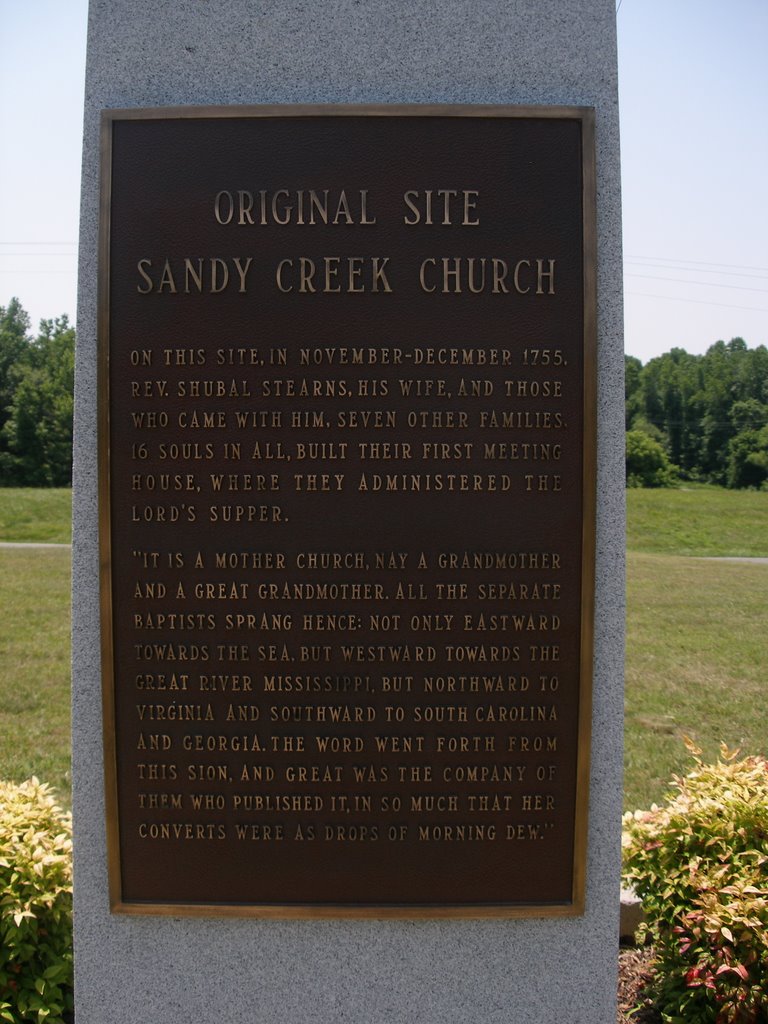
This morning I awoke in Greensboro, NC. Together with my in-laws, there are nine of us here. Under tremendous pressure from me, the whole group assembled and drove thirty miles out into the country to attend Sandy Creek Baptist Church. That's right...THE Sandy Creek Baptist Church. In 1755 a guy named Shubal Stearns planted the Sandy Creek Baptist Church, the mother church of the Separate Baptist movement. Much of who we as Southern Baptists are...well, it arises from the banks of that little ditch.
So we strolled in and discovered that we had arrived on business meeting Sunday. Today was the day of their big vote on plans for a new building. It seems that SCBC can no longer hold all of its attendees. The church's steady growth over the past few years has paved the way for a new facility. The church voted 85%-15% to go forward. Sandy Creek Baptist Church not only has a past; it has a future.
I think I know why. The pastor was obviously elated over the vote, but he spent more time extending genuine pastoral care and counsel to the 15% than anything else. This pastor gave genuine pastoral leadership, yet did so without abandoning or demonizing those who might have a difference of opinion. The Sunday School lesson and the sermon were sound, biblical, solid fare upon which Christians can grow. The pastor is a stable influence, a compassionate man without being mercurial or flashy, and a man committed to truth and exposition. The people were very friendly, genuinely welcoming to our presence and familial toward one another. The facility buzzed with excitement today—obviously somewhat about the vote, but more about the church. They know where they are going and they are thrilled about it.
The foundation at Sandy Creek Baptist Church is not some faddish human philosophy from Willow Creek or Saddleback. These people have been around too long to jump onto every bandwagon that rolls by. It is really quite simple: They've been around as a church long enough to know that God is their foundaiton and can get them through anything. They're strikingly unaware of their historical prominence. In their minds, they are simply a country Baptist church that God has kept around for a long time. There are no big egos at SCBC.
Sandy Creek Baptist Church is success, as far as Southern Baptists go. Our convention rises and falls as churches like this rise and fall. We never have been, are not today, and never will be a convention of megachurches. The fact of the matter is this: Being Baptist doesn't work all that well with being a megachurch. You can do it, but it presents all kinds of special challenges to your Baptistness. Even today, the majority of our churches are small. Most Southern Baptists attend a small, simple church. You wouldn't know it from the program of the SBC Annual Meeting. That's fine with me...the program ought to feature people who have distinguished themselves. But it does worry me that the emphasis upon megachurches may cause us to lose sight of what we really are: a convention of small churches. The pastor at SCBC may have a lot more to teach us about Southern Baptist Success than Ronnie Floyd, Frank Page, or even my candidate.
Tonight I have the option of going down to the Greensboro Colliseum to listen to Saddleback Rick. I think I'm going to drive back into the country instead.
Subscribe to:
Posts (Atom)